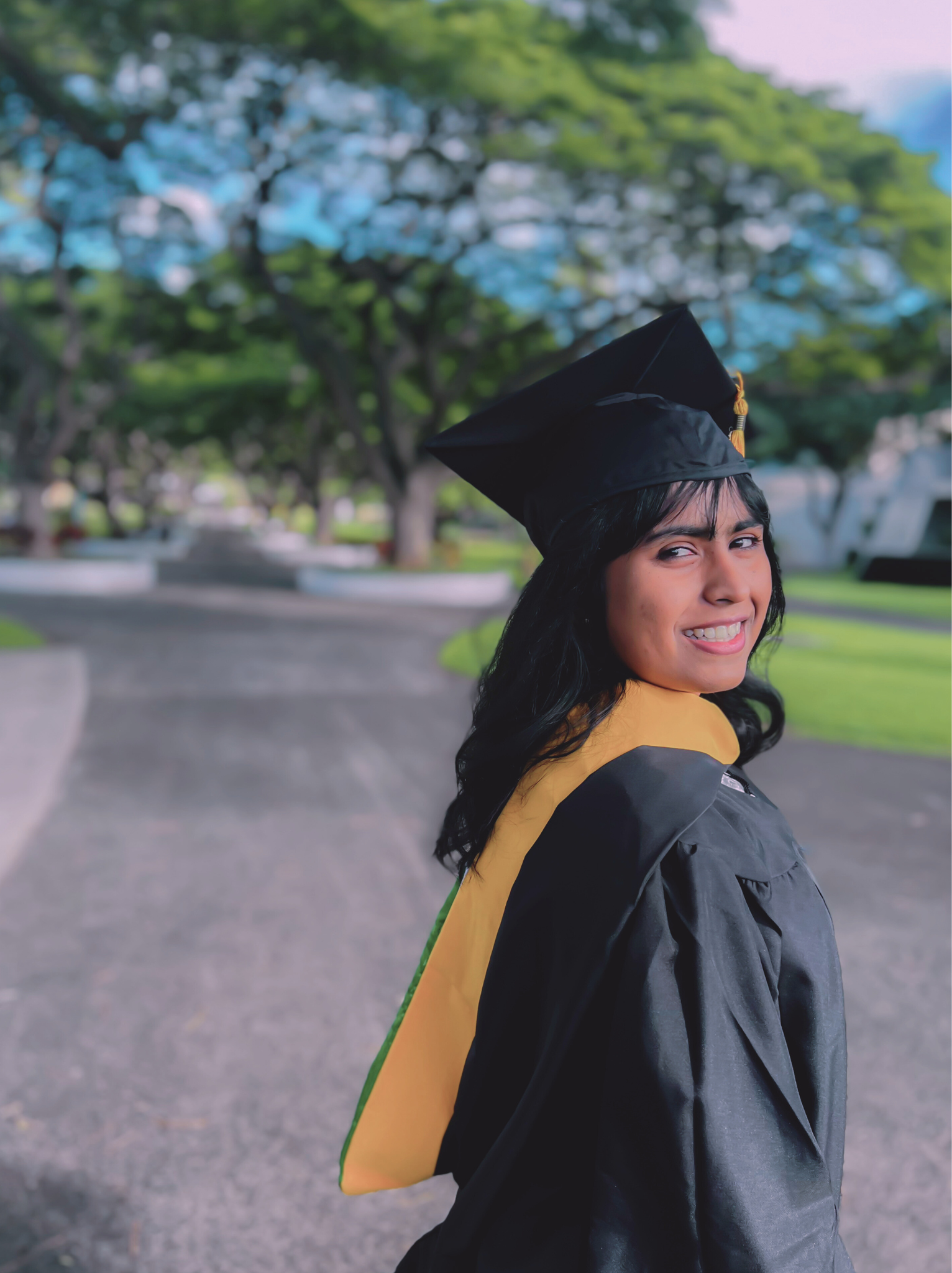
PhD Candidate, Institute for Astronomy, University of Hawai'i
About
I am a fifth-year PhD candidate working in adaptive optics and high contrast imaging, at the Institute for Astronomy, University of Hawai'i. I am from Dubai, United Arab Emirates, where I lived for 18 years before moving to Los Angeles for my undergraduate degree. So yeah, I have come a long way to where I am today– about 13,800 kilometres. I am currently based in the WM Keck Observatory headquarters in Waimea, on Big Island.
I received my bachelors in 2020 from the University of California, Los Angeles, where I double-majored in Geophysics and Astrophysics, graduating magna cum laude and with highest departmental honors.
My research, since my undergraduate years, has been motivated by the question: "How did our planet and its neighbourhood come to be?"
I was led to my current research through a very indirect path paved by a combination of my classes and various undergraduate research projects that came under an umbrella of fossils of the Solar System.
Having mapped meteorite samples and studied their mineral composition (with Prof. Kevin McKeegan, UCLA), constructed and analyzed models of condensation on planetary embryos (with Prof. David Stevenson, Caltech),
and reduced cometary images to understand their morphology and study their activity (with Prof. David Jewitt),
I indeed developed a greater appreciation of our neighborhood that I wanted to further investigate planetary systems and how they come to be.
My first-year grad project on a debris disk sealed this interest and pushed it more along the lines of direct imaging, which also inspired my field of focus for instrumentation.
Currently, I am working on the upgrade of the deformable mirror of Keck II telescope's adaptive optics system, which will enable exploration of a whole new regime of exoplanets and in-depth understanding of protoplanets in their nascent disks via
direct imaging and spectroscopy. My instrumentation work is also coupled with my research on the characterization of the protoplanetary disks that are optically faint, but bright in the infrared, which are the disks that are most likely to host planets in their early stages of formation.
You can read more about my research in the Projects section.
When I am not science-ing, I immerse myself into mysteries, historical- and science-fiction literature and cinemedia , writing (a mix of blogging on Medium and my social media), art and photography, music,
puzzles (crosswords, jigsaw puzzles, and the like), and some physical activity — from a brisk walk to a long hike, table tennis, and snorkeling & scuba diving... all of which keep me hale and hearty, besides chocolate and coffee!
I am also involved in a lot of public outreach and science communication within and beyond Hawai’i, which you can read more about in the Outreach section.
Research
Much of my research is about seeing things that are difficult to see.
From the ground, Earth's atmosphere blurs astronomical images. Even after we correct
for that blur, stars are so bright that they can hide nearby planets and the disks in
which planets form. My work spans both the tools we build to overcome these problems
and the science we can do once we do.
My research broadly falls into three connected areas:
adaptive optics, high-contrast imaging, and planet formation in circumstellar disks.
Adaptive Optics
Why do we need adaptive optics?
A telescope collects light and focuses it to form an image. In ideal conditions,
a large telescope such as Keck can produce extremely sharp images.
But before light from a star reaches a telescope on the ground, it has to travel
through Earth's atmosphere. Different pockets of air have slightly different
temperatures and densities, which continually disturb the light passing through them.
Instead of arriving at the telescope as a smooth wave, the light becomes distorted.
This is why stars appear to twinkle to our eyes — and why astronomical images
taken from the ground are naturally blurred.
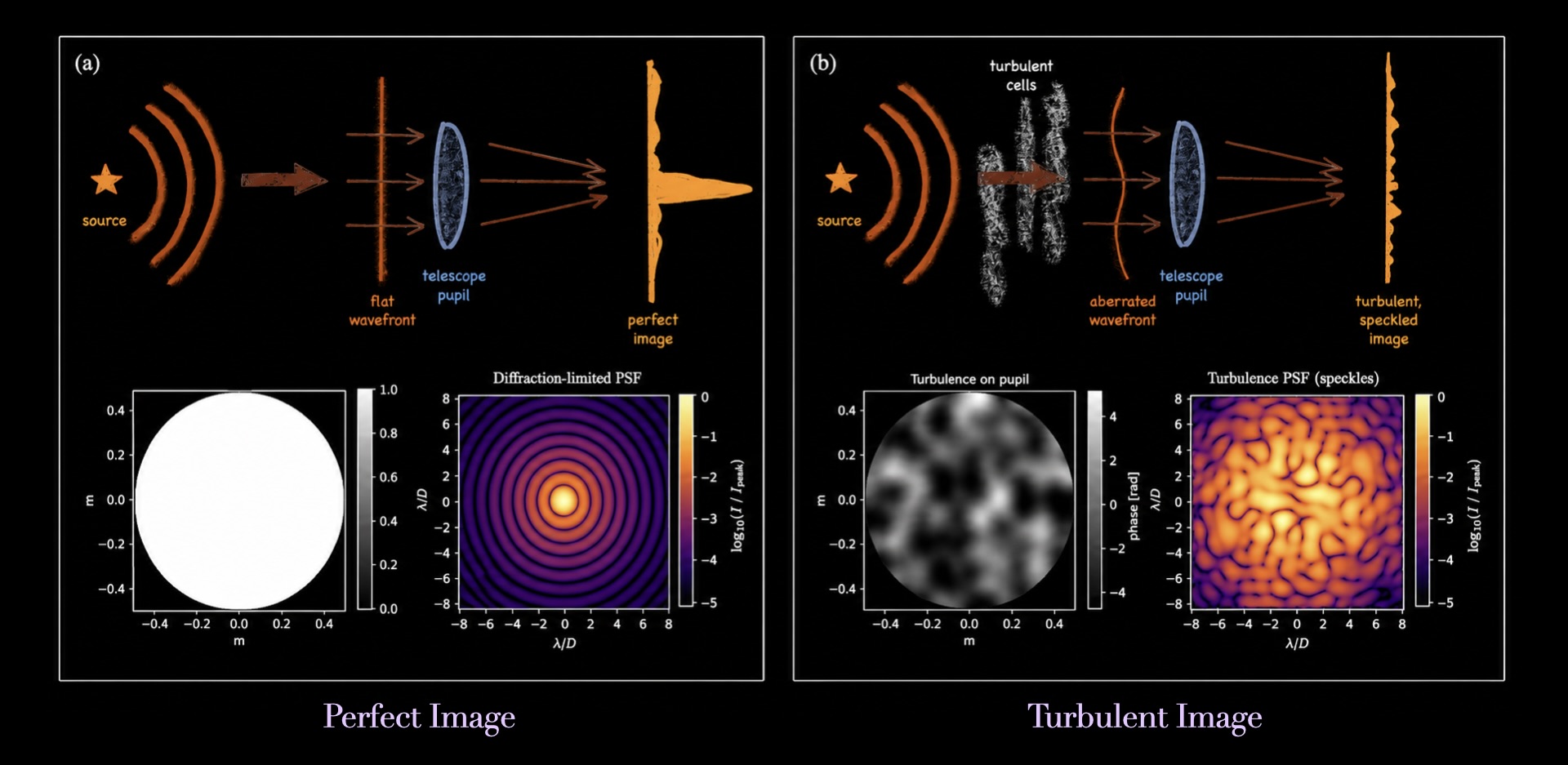
In ideal conditions, a flat wavefront produces a sharp diffraction-limited image.
Atmospheric turbulence distorts that wavefront and spreads the light into a speckled image.
Correcting the atmosphere
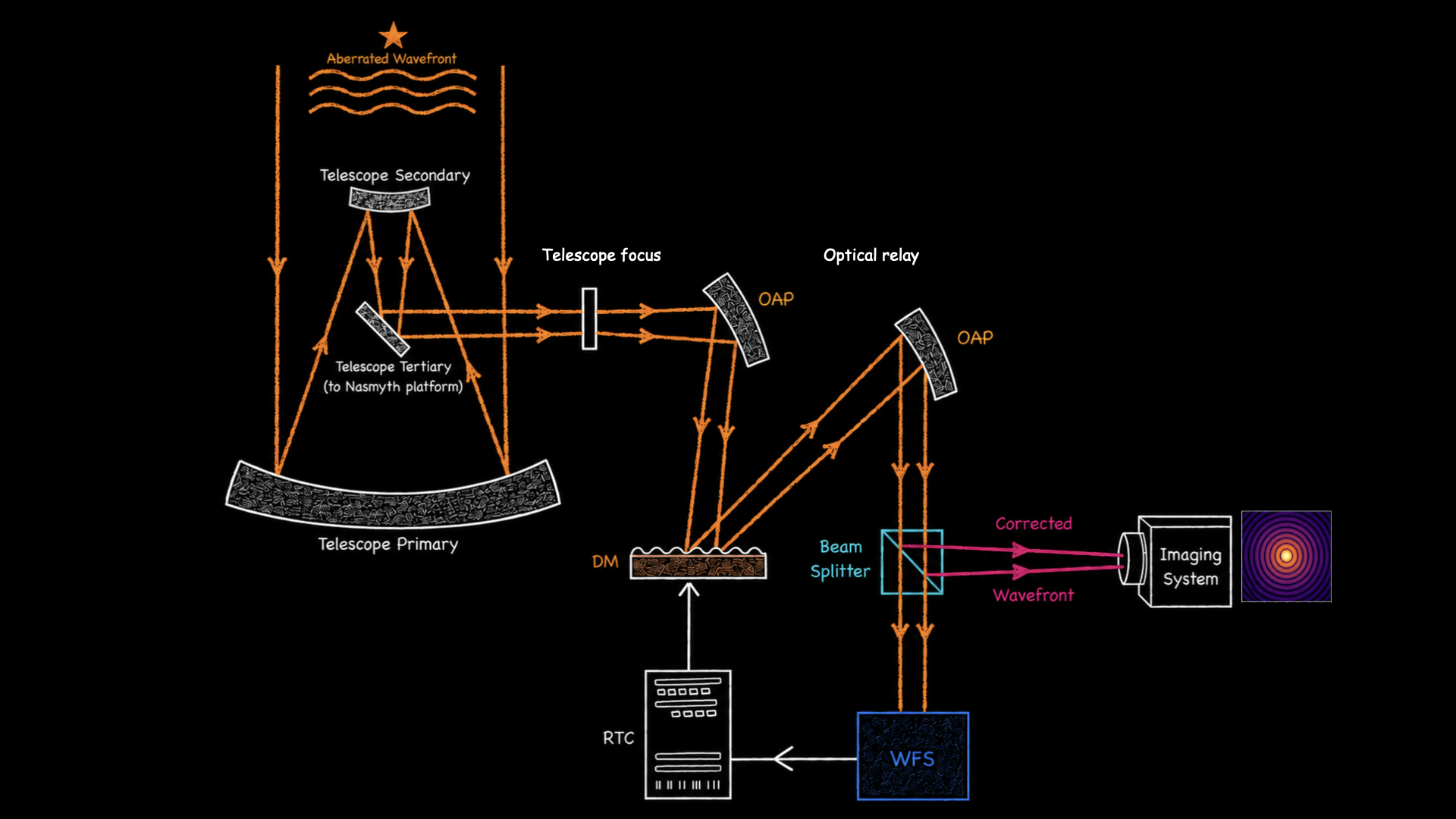
Adaptive optics, or AO, is a way of correcting
these distortions in real time.
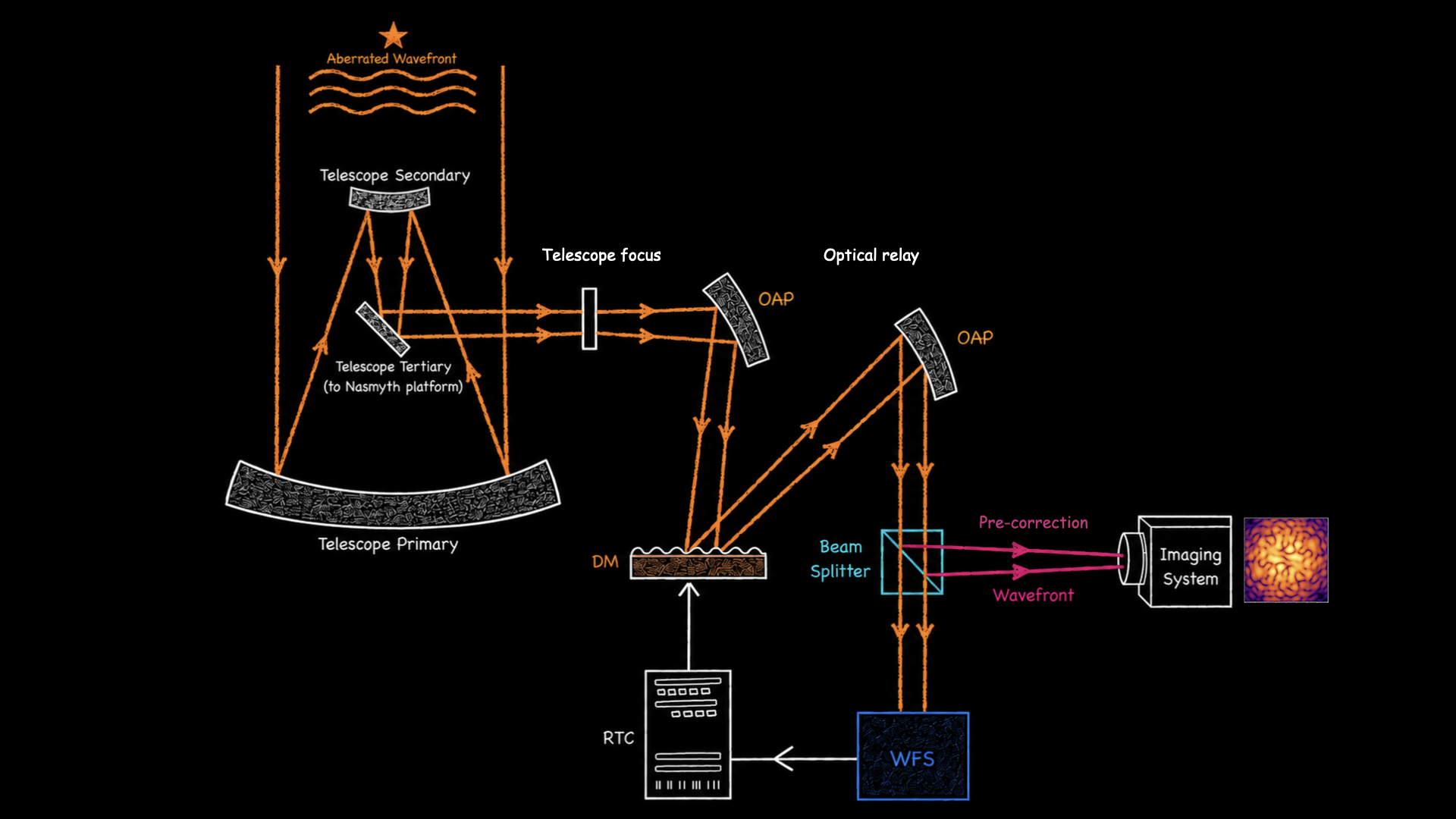
An AO system measures how the incoming light has been distorted and calculates
the correction needed to undo it. A deformable mirror then changes
its shape to apply that correction. This process is repeated hundreds or thousands
of times every second as the atmosphere changes.
Explore the diagram below: switch between the pre-correction and corrected states,
then click a component to see what it does.
Explore the AO loop
Incoming wavefront
This wavy pattern represents starlight after it has passed through Earth's atmosphere.
Instead of arriving as a smooth, flat wavefront, the light is distorted — which blurs
the final image.
An adaptive optics system therefore has three main jobs: measure the
distorted light, calculate the correction, and reshape
a deformable mirror to apply it.
The better we can measure and correct the atmosphere, the sharper the final
astronomical image becomes.
High-Contrast Imaging
Seeing something faint beside something bright
Imagine trying to photograph a firefly sitting next to a lighthouse.
That is similar to the challenge of directly imaging a planet next to its star.
A planet can be thousands, millions, or even billions of times fainter than the
star it orbits. Circumstellar disks can also be overwhelmed by the light of
their central stars.
Adaptive optics sharpens the image, but the star still produces a bright pattern
of light around itself. Small imperfections in the atmosphere and telescope also
leave behind bright spots called speckles, which can hide or even
mimic the faint objects we are trying to detect.
High-contrast imaging combines several techniques to remove as
much of this unwanted starlight as possible.
Blocking the star
One of these tools is a coronagraph. A coronagraph is placed
inside the instrument and suppresses light from the bright central star while
allowing much of the surrounding light to continue to the camera. This makes
faint material close to the star much easier to see.
Separating real signals from leftover starlight
A coronagraph cannot remove all of the starlight, so astronomers also use
special observing and image-processing techniques to distinguish real
astronomical signals from the remaining speckles.
Angular Differential Imaging (ADI) uses the rotation of the sky
relative to the instrument. As the telescope tracks the star, a real planet or disk
feature changes its angle around the star on the detector, while the instrumental
speckle pattern stays roughly fixed. The images can then be combined to subtract
the fixed pattern, rotated back into alignment, and stacked so that the real
astronomical signal adds together.
Other techniques use different properties of the light.
Reference Differential Imaging (RDI) compares the target with
observations of another star to build a model of the unwanted stellar light.
Spectral Differential Imaging (SDI) uses the way speckles change
with wavelength, while Polarimetric Differential Imaging (PDI)
uses the fact that light scattered by circumstellar dust can be polarized
differently from the direct light of the star.
Together, adaptive optics, coronagraphy, and differential imaging allow us to
directly study faint objects and structures very close to bright stars.
What can we see?
High-contrast imaging can be used to study planets orbiting other stars,
young planets that are still forming, brown dwarfs and other faint companions,
and the dusty circumstellar disks surrounding young stars.
The last of these is where much of my science work is focused.
Planet Formation & Circumstellar Disks
Where do planets come from?
Stars and planets form together.
A new star begins inside a cold cloud of gas and dust. As part of that cloud
collapses under gravity, material falls toward the young star. Because the cloud
is rotating, not everything falls directly onto the star. Instead, much of the
material settles into a flattened disk around it.
This is a circumstellar disk. When the disk is young and still
rich in gas and dust, we call it a protoplanetary disk. It
contains the raw material from which planets are built.
Small dust grains collide and grow into larger grains, pebbles, planetesimals,
and eventually planets. At the same time, the disk itself evolves: material
falls onto the star, becomes incorporated into planets, or is dispersed into space.
Disks are not smooth
High-resolution observations have shown that protoplanetary disks contain a
remarkable variety of structures. We see rings, gaps, spirals,
cavities, and shadows.
Some of these structures may be produced by planets interacting with the disk
around them. Others can result from changes in the gas and dust, the way the
disk is illuminated, magnetic effects, or different parts of the disk being
tilted relative to one another.
That makes disks valuable laboratories for studying planet formation. We may
not always see a young planet directly, but we can study the environment in
which it is forming — and sometimes the structures it creates.
Looking at disks in different kinds of light
There is no single wavelength that shows us an entire disk.
At millimeter wavelengths, telescopes such as ALMA are especially
sensitive to larger dust grains concentrated closer to the disk midplane.
In the near-infrared, we often see much smaller grains higher
above the disk. These grains scatter light from the central star toward us,
allowing us to map the illuminated surfaces of disks, envelopes, and outflow cavities.
Comparing these different views gives us a more complete picture of how material
is distributed around young stars and how these systems are evolving.
My work is particularly interested in young, embedded systems —
objects that can be difficult to observe at visible wavelengths because they are
still surrounded by large amounts of dust. Near-infrared adaptive optics and
high-contrast imaging give us a way to explore this younger stage of planet formation.
From Tools to Discoveries
My work spans both sides of this process: developing and testing the technologies
that make high-resolution imaging possible, and using those techniques to study
young planetary systems.
A running collection of instrumentation and science projects I have worked on.
Adaptive Optics & Instrumentation
High-order Advanced Keck Adaptive Optics (HAKA)
HAKA is a major upgrade to the Keck II adaptive optics system. It replaces the
original 349-actuator Xinetics deformable mirror with a 2,844-actuator ALPAO
electromagnetic mirror, together with an upgraded Shack–Hartmann wavefront sensor
and real-time controller.
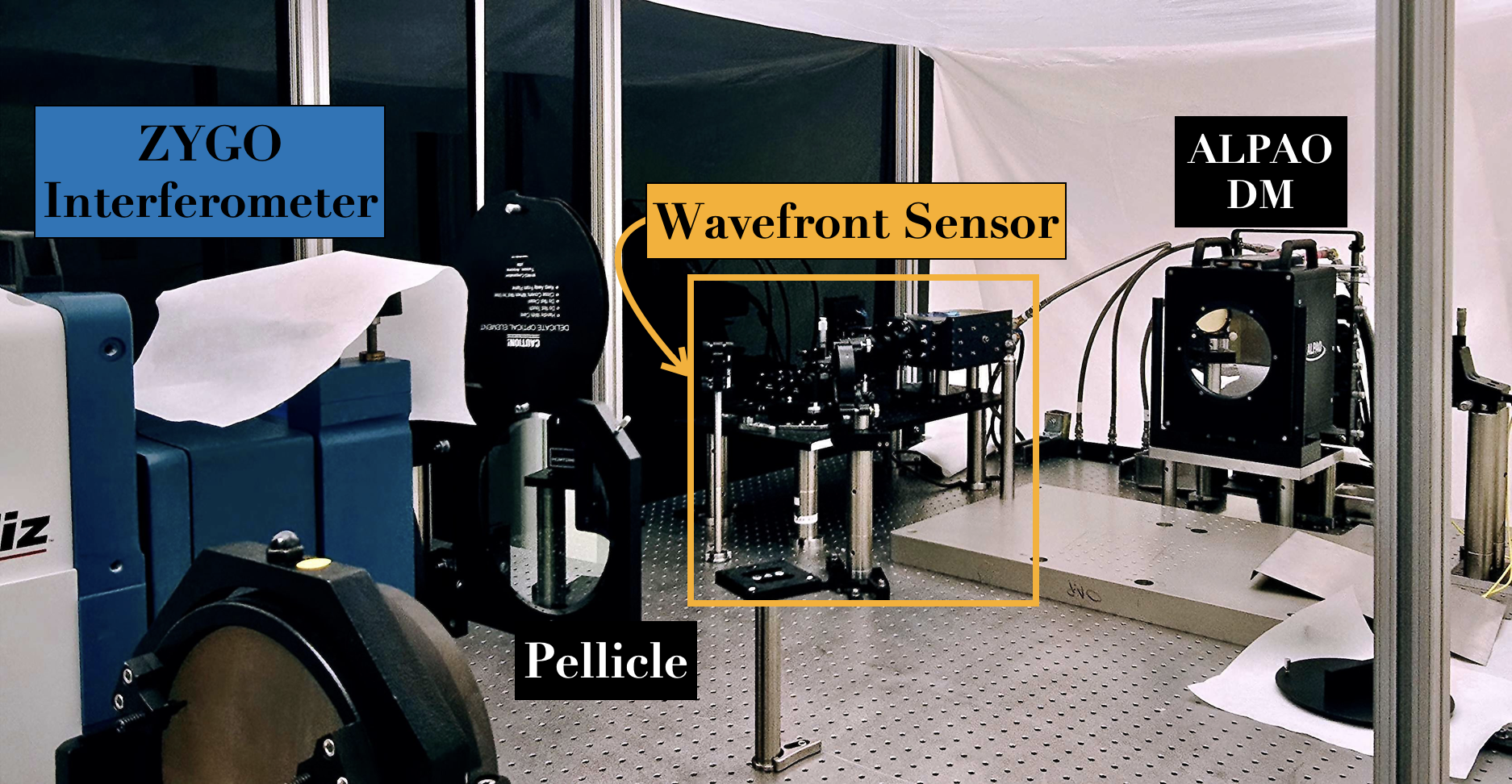
At Keck Observatory I led the deformable-mirror site acceptance testing and
characterization. This included aligning the test bench, mapping actuator response,
building gain maps, flattening the mirror, measuring stroke, linearity, hysteresis,
and creep, and supporting closed-loop testing and on-sky commissioning.
HAKA achieved first on-sky correction in March 2026 and K-band Strehl ratios of
about 0.71–0.76 on bright guide stars during commissioning.
AO3k upgrades Subaru Telescope's adaptive optics system with a much higher-order
ALPAO deformable mirror, new wavefront-sensing capability, and an upgraded real-time
controller. I supported site-acceptance testing of the new deformable mirror,
including functional checks and measurements of actuator response and gain.
Focal-Plane Speckle Suppression
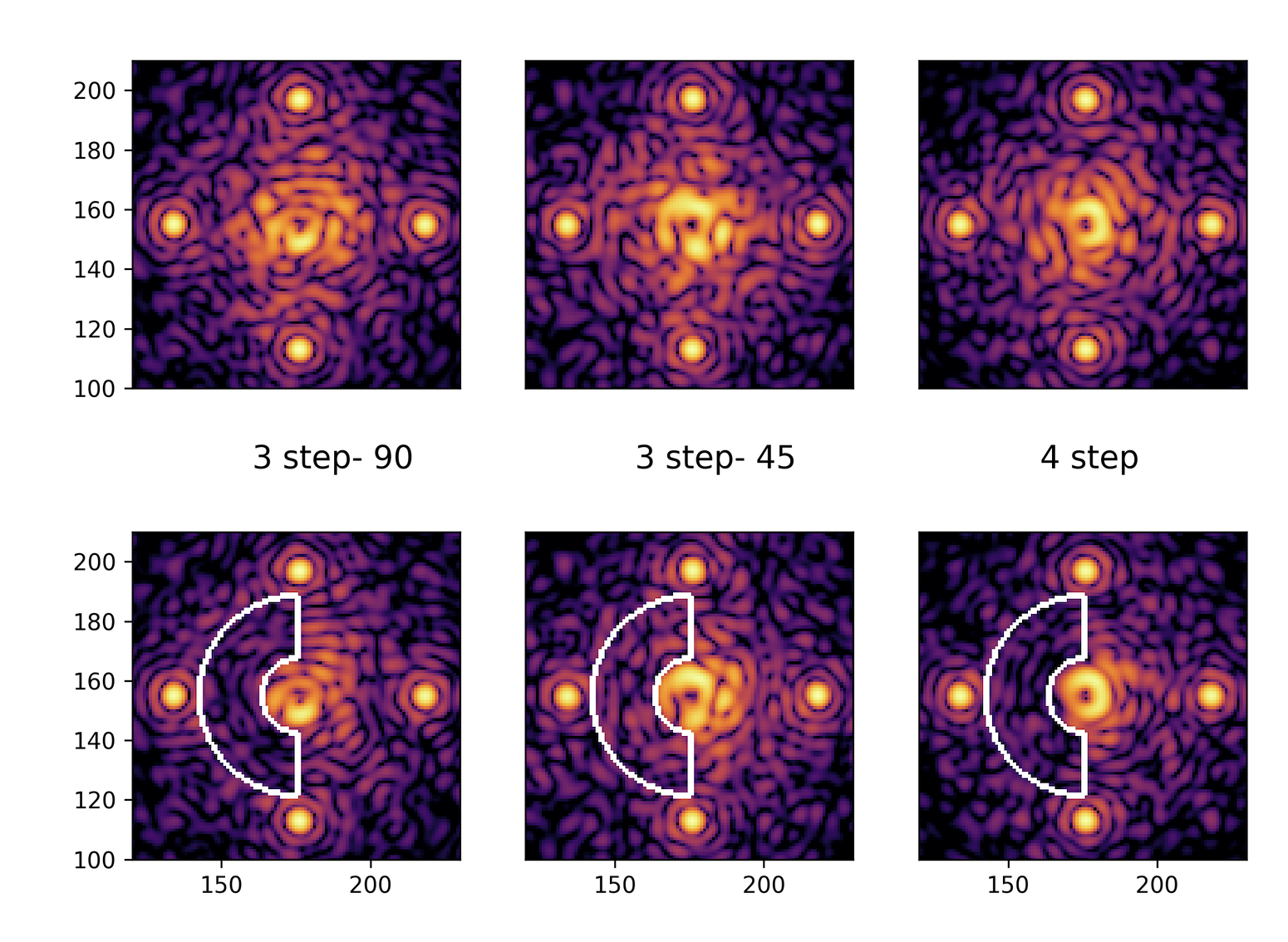
Residual speckles can mask faint disks or companions even after adaptive-optics
correction. I have tested focal-plane methods that probe and cancel these speckles
with the deformable mirror directly in the science image, with the goal of making
practical on-sky wavefront control faster and more stable.
I have worked on testing and characterization of the C-RED ONE detector in
preparation for its use with the Keck II adaptive optics system and infrared
pyramid wavefront sensing.
Direct Imaging & Circumstellar Disks
IRAS 23077+6707 — “Dracula's Chivito”
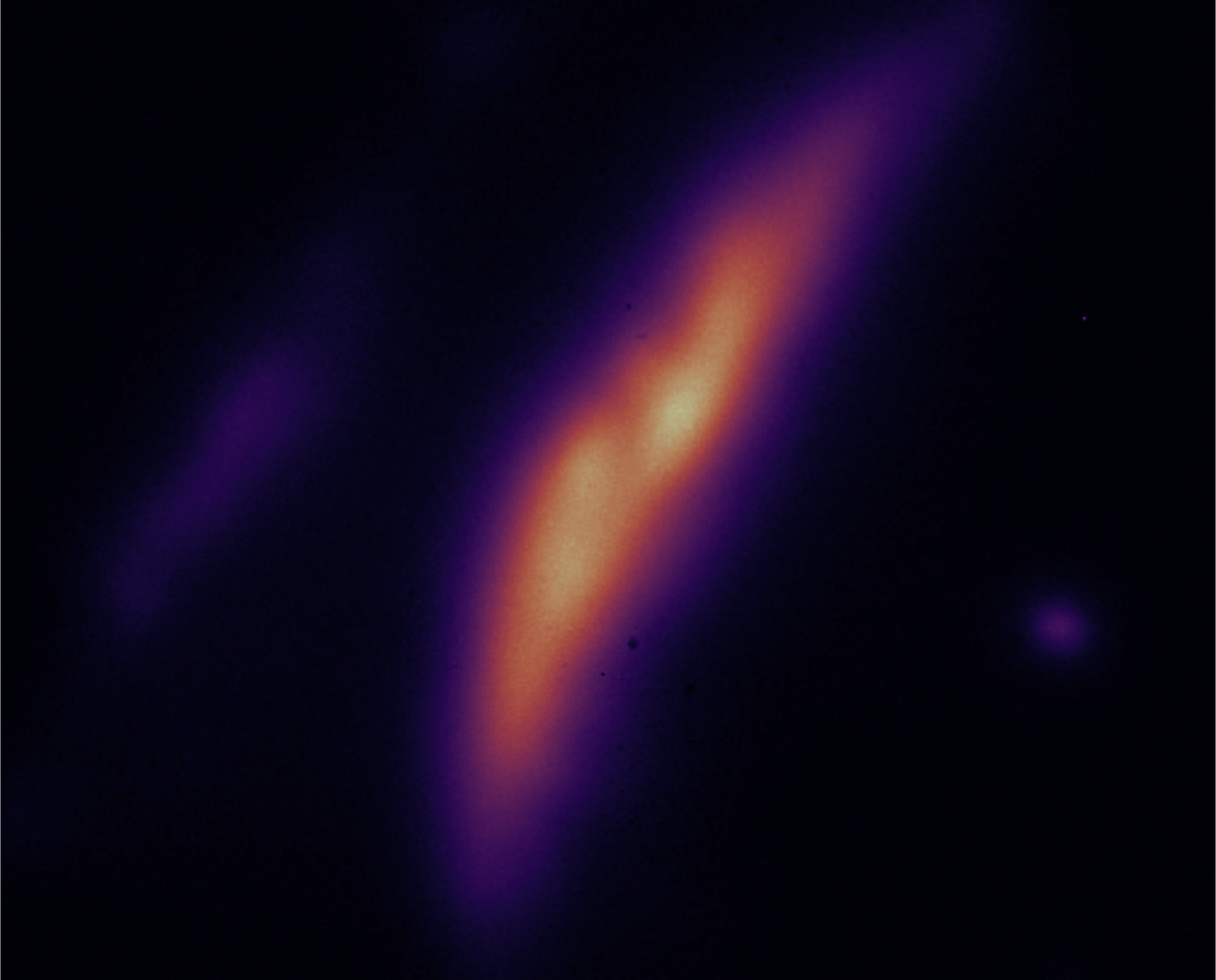
Using Subaru/IRCS imaging in J, H, and Kp bands, I studied the morphology and
near-infrared colors of this unusually large, nearly edge-on young disk system.
The color distribution points to different scattering and extinction regimes,
while the wide dark lane and offset host star indicate that the system cannot be
explained by a disk alone and is likely surrounded by a substantial asymmetric envelope.
V883 Ori
I used Subaru/SCExAO+CHARIS polarimetric imaging to study the embedded,
outbursting young star V883 Ori. The near-infrared polarized light traces the
near-side wall of a wide-angle outflow cavity rather than simply the disk surface.
Its red scattered-light color also shows that the light passes through substantial
dust along the way, giving us a view of how the surrounding material is being cleared.
V2254 Ori / Becklin-Neugebauer
Using Subaru/SCExAO+CHARIS polarimetric imaging, I studied the deeply embedded
Becklin-Neugebauer object in Orion's OMC-1 cloud. The observations recover a
bipolar scattered-light structure. Its near-infrared colors are consistent with
scattering by small porous aggregate grains, with an additional contribution from
foreground polarization produced by aligned dust in the molecular cloud.
Outreach
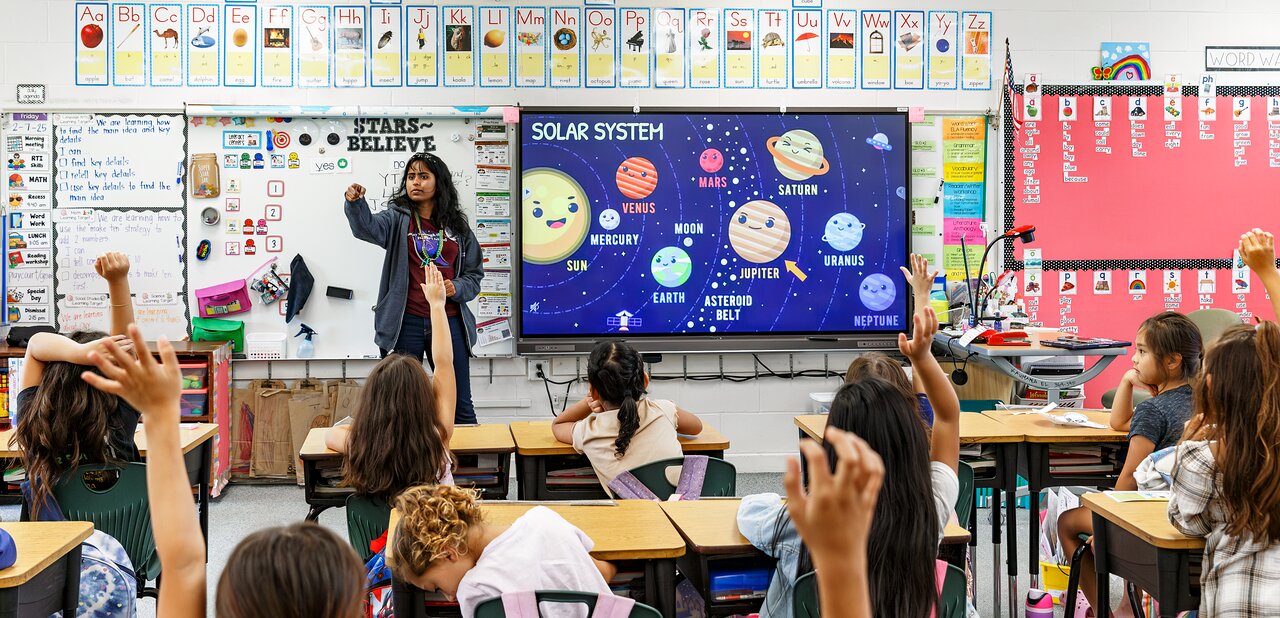
A glimpse of a session of Journey Through the Universe
I am keen on communicating my science — what I do and what I have learned. And I believe bringing their work to the general public is a social responsibility of every scientist, considering that their research is in part, if not wholly, funded by taxpayer dollars.
As such, I have been involved in various outreach and science communication activities, both within and beyond the US. These include public talks, school visits, and other astronomy and STEM events.
It is more than just fun and fulfilling to introduce the next generation of scientists to the ever-evolving astronomical research and technology; their curiosity and enthusiasm is quite inspiring and helps us appreciate our work and understand it better.
Classroom Visits
I have interacted with students all the way from kindergarten to high school, in the US and internationally. These visits usually involve a presentation on my research and career path, followed by a Q&A session.
Some of these visits were invited talks, and some were co-ordinated through programs established to connect school students with scientists in astronomy or any STEM field of their choice.
Journey through the Universe
Journey Through the Universe is an astronomy education program catered to students in public schools in the Hilo-Waiākea school distric of Hawai'i island, promoting STEM literacy and careers through classroom visits, career panels, and planetarium presentations.
Students have the opportunity to envision themselves in STEM careers and experience the unique science happening in Hawai'i and beyond through the yearly classroom visits of astronomers, engineers and other STEM professionals focusing on the Maunakea Observatories.
This program is a tremendous endeavour that foster curiosity about the cutting-edge research and technology that is allowing us to understand our place in the cosmos, and briding the gap between the local Hawaiʻi community and the astronomical research and development facilitated by the telescopes on Maunakea.
I have been involved in this program since 2022, and have visited several schools in the Hilo-Waiākea district, talking to students about the Solar System, star and planet formation, and the tradition of astronomy in Hawai'i.
Skype a Scientist
Skype a Scientist is a program that connects scientists with classrooms around the world, allowing students, and any group of interested individuals from various communities to interact with scientists in real-time through video calls.
I have been involved in this program since 2021, where I have had the opportunity to talk to students from various countries across North America, Europe, and Asia.
These interactions have been a great way to share my research and career path, and to answer questions about astronomy and my experiences as a scientist. Through some of these virtual visits, I have established connections with host classrooms and teachers, and have been invited for follow-up visits to their schools, either virtually or in-person.
High School Programs
I have been involved in several high school programs, as a mentor, and volunteer. These programs are designed to provide high school students with an opportunity to explore STEM knowledge beyond the school curriculum,
undertake research project, and come in contact with scientists and engineers to help them envision themselves in STEM careers.
Some of these programs include:
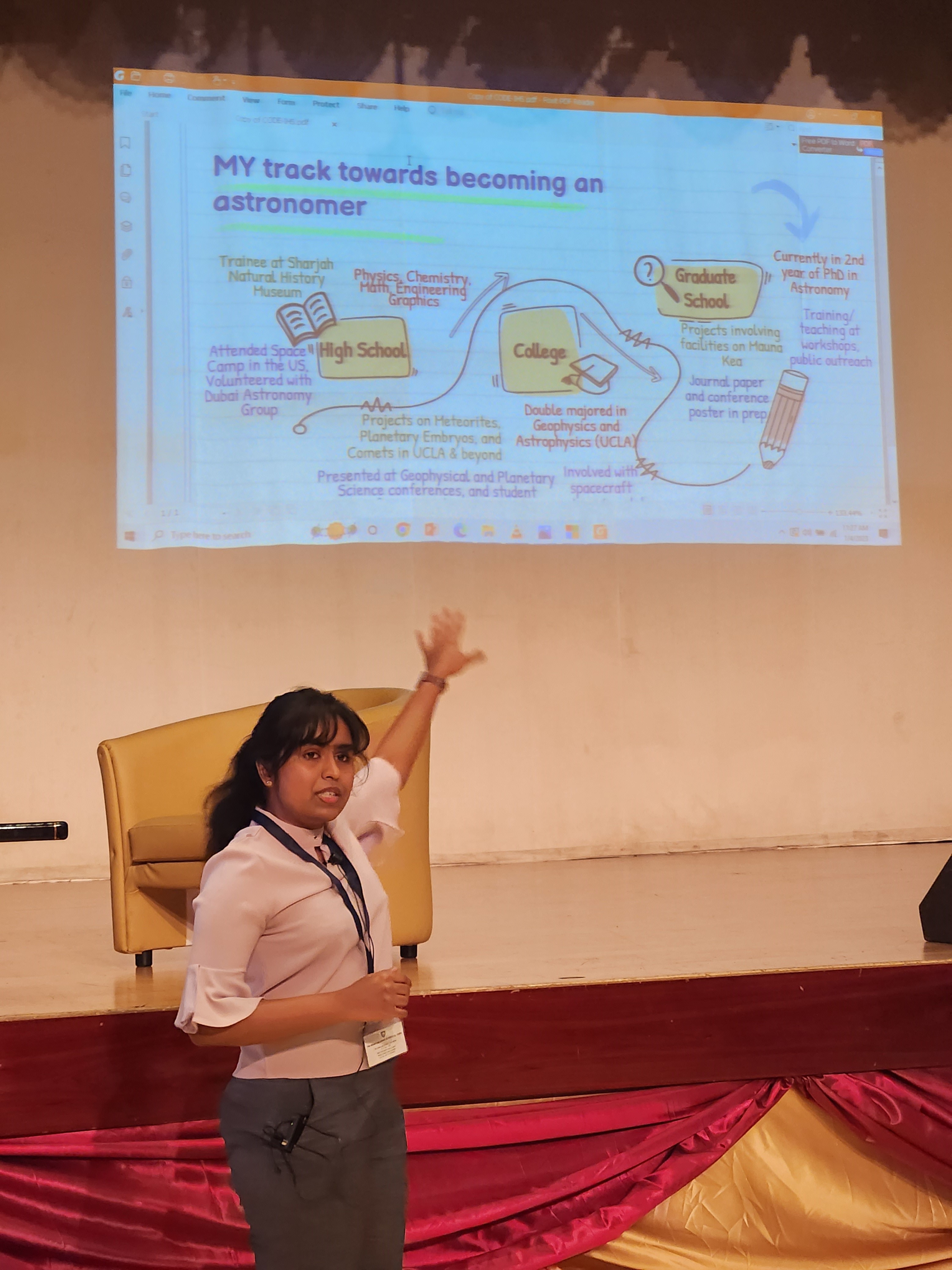
Speaking at IHS, Dubai
Hawai'i State Science and Engineering Fair (Judge)
Hawai'i State Science Olympiad (Event Supervisor)
Maunakea Scholars (Mentor)
Career Opportunities, Development & Enrichment, Indian High School, Dubai (Guest Speaker)
Public Events
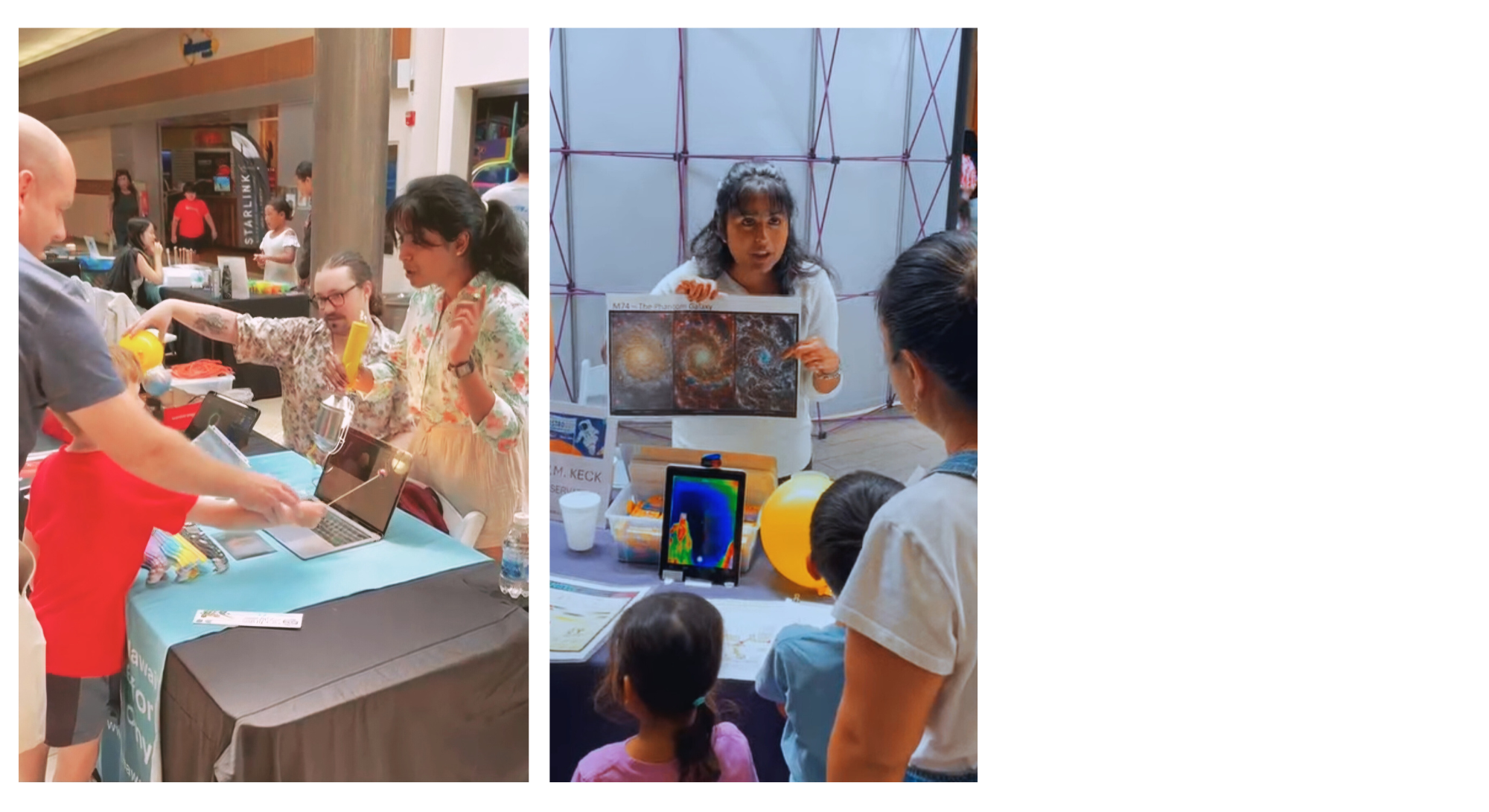
AstroDay Hilo
In addition to classroom visits, I have also been involved in various public events, such as science fairs, stargazing nights, and other community events.
These events provide an opportunity for the general public to learn about astronomy and science in a fun and engaging way.
Some include:
This is bold and this is strong. This is italic and this is emphasized.
This is superscript text and this is subscript text.
This is underlined and this is code: for (;;) { ... }. Finally, this is a link.
Heading Level 2
Heading Level 3
Heading Level 4
Heading Level 5
Heading Level 6
Blockquote
Fringilla nisl. Donec accumsan interdum nisi, quis tincidunt felis sagittis eget tempus euismod. Vestibulum ante ipsum primis in faucibus vestibulum. Blandit adipiscing eu felis iaculis volutpat ac adipiscing accumsan faucibus. Vestibulum ante ipsum primis in faucibus lorem ipsum dolor sit amet nullam adipiscing eu felis.
Preformatted
i = 0;

while (!deck.isInOrder()) {
    print 'Iteration ' + i;
    deck.shuffle();
    i++;
}

print 'It took ' + i + ' iterations to sort the deck.';

 A glimpse of a session of Journey Through the Universe
 Speaking at IHS, Dubai
 AstroDay Hilo